Talent Acquisition × AI
Why AI Hiring Tools Give Conflicting Advice (and Why It Matters for TA Leaders in 2026)
Based on real TA leader questions — April 2026 — People Science
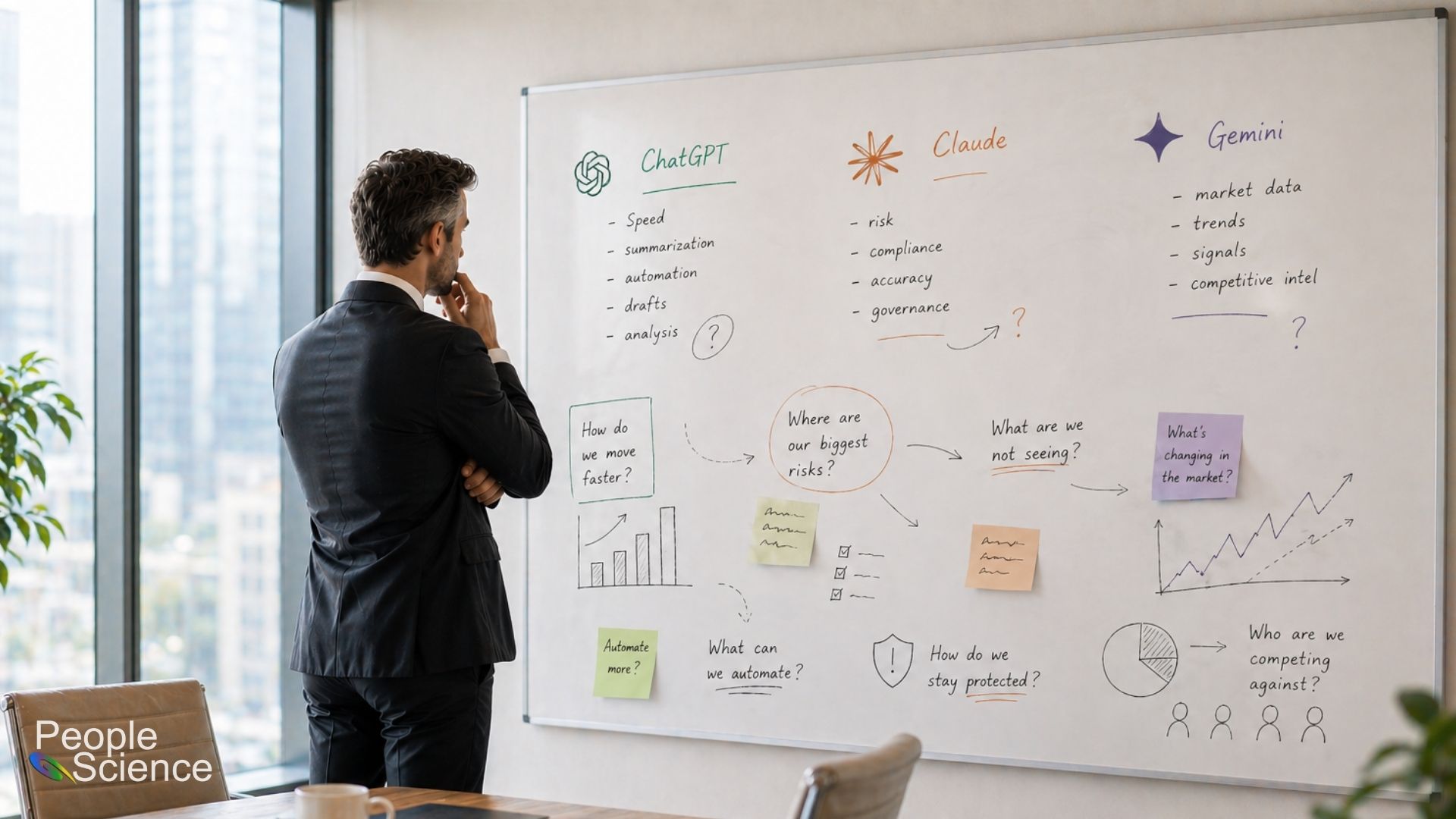
AI hiring tools often give conflicting advice. Yes, AI is changing the way we work—but if you’ve used ChatGPT, Claude, or Gemini, you’ve probably seen how inconsistent those answers can be.
For the past few years, it’s been everywhere—every platform, every conference, every newsletter leading with some version of the same idea. And while it’s true, what’s emerged is a sea of posts with similar urgency and vagueness. The result isn’t clarity. It’s options fatigue for the leaders expected to make decisions.
So I approached this differently. I’ve been using AI daily for my own work, not theorizing about it, actually using it, and it got me thinking: how do we know what TA leaders are really looking for? Instead of guessing, I went to the source.
What I found was more useful than another general point of view. The questions TA leaders are asking cluster into five distinct zones. Not categories someone invented in a conference room—real intent. What people are searching, bringing into conversations, and struggling to answer.
Then I took it a step further. I looked at how ChatGPT, Claude, and Gemini respond to those questions and why they often give different answers to the same problem. Understanding that gap is one of the most practical AI skills a TA leader can develop right now.
Why the Models Conflict and Why It Matters
ChatGPT, Claude, and Gemini were not trained on your recruiting data. They were trained on broad internet text, ethics literature, and live web indexes. When you ask a vague question, each fills gaps with its own defaults.
That’s not a bug, it’s a mismatch. Korn Ferry found that 65% of TA leaders describe AI advice as too generic to act on. The fix isn’t finding the right model. It’s knowing which model to use for which type of problem.
GoodTime’s 2025 survey put adoption at 99%, with 93% of TA teams planning to expand AI use. Expansion without a framework for evaluating conflicting outputs creates more confusion at higher volume.
The Five Question Categories TA Leaders Are Actually Asking Right Now
What became clear quickly is that these questions are not all the same type. Some are immediate and executional. Others are evaluative. Others are strategic.
This matters because AI models respond differently depending on the type of problem being asked—a key reason outputs often feel inconsistent or generic.
Based on what leaders are searching, discussing, and struggling with, the questions cluster into five zones:
1. Signal vs. Noise: Does AI Actually Work for Hiring?
This is the dominant cluster, and the most poorly served by existing content. The gap between vendor promises and measurable outcomes is significant. Leaders want proof, not demos.
The questions practitioners are asking:
- Which AI sourcing tools are actually moving metrics like time-to-fill and quality-of-hire?
- How do I evaluate AI vendor claims without a data science team?
- Is AI screening improving my pipeline, and how would I know?
- What does a real AI recruiting ROI calculation look like?
Model behavior in this category:
- ChatGPT builds scorecards, ROI templates, and evaluation frameworks.
- Claude flags what vendors aren’t saying, including bias risks and weak assumptions.
- Gemini surfaces benchmarks and peer adoption data.
People Science note: The highest-value answer here is longitudinal data, not model output. HireGate tracks real-time sourcing metrics across clients, providing ground truth AI models cannot generate.
This category is also where AI is most often used for execution first and evaluation second, which contributes to differing outputs.
Sources: GoodTime AI Surge 2025; i4cp TA Trends 2025; Korn Ferry Challenges 2025
2. Compliance and Risk: What Can Get Me Sued?
Regulatory exposure is accelerating faster than most TA teams can track. NYC Local Law 144, the EU AI Act, and EEOC requirements create real liability. Leaders need clear guidance, not legal boilerplate.
The questions practitioners are asking:
- How do current regulations affect the tools I’m using?
- Is my AI screening tool audited for bias, and who owns that liability?
- How do I document AI-assisted decisions for compliance?
- Do candidates have a right to know AI screened them?
Model behavior in this category:
- ChatGPT generates checklists and documentation templates.
- Claude reasons through governance and edge cases.
- Gemini provides current regulatory updates and enforcement examples.
62% of TA leaders cite hidden AI bias risk as a top concern. These are active compliance issues, not theoretical ones.
Sources: Korn Ferry 2025; NYC LL144; EU AI Act implementation timeline
3. Team and Budget: Will AI Replace My Recruiters?
The org design question is real but often oversimplified. TA leaders face pressure to reduce headcount while teams want clarity on how their roles will change.
The questions practitioners are asking:
- How do I justify shrinking or protecting headcount using AI data?
- What roles are being replaced versus augmented?
- How do I reskill my team?
- What is the right human-to-AI task split?
Model behavior in this category:
- ChatGPT builds workflows and business cases.
- Claude models tradeoffs between automation and human interaction.
- Gemini surfaces how peer organizations are restructuring teams.
Recruiters are managing significantly more requisitions year over year. That load requires AI support, but where and how it is applied varies. Much of the divergence here comes from models operating at different levels while TA leaders manage both.
Sources: GoodTime 2025; i4cp TA Trends; Korn Ferry headcount data
4. Candidate Experience: Are We Losing Candidates to AI?
Employer brand concerns are rising as AI touches more of the candidate journey. Many candidates abandon AI-heavy application flows, yet response plans are often unclear.
The questions practitioners are asking:
- How do candidates feel about AI-driven hiring processes?
- Is AI outreach affecting our employer brand?
- How do we maintain a human experience with automated touchpoints?
Model behavior in this category:
- ChatGPT improves messaging and communication.
- Claude defines where automation should stop.
- Gemini surfaces candidate sentiment and benchmark data.
The most actionable input here is primary research. Candidate feedback distinguishes tolerance from preference. This category often focuses more on efficiency than downstream impact, creating a gap between implementation and outcome.
Sources: Business Insider candidate drop-off data 2025; GoodTime experience metrics
5. Strategy: Where Do I Even Start?
Many TA leaders are overwhelmed by options and lack clear frameworks for decision-making. This creates high friction but also high potential return.
The questions practitioners are asking:
- What should we prioritize first in AI adoption?
- Build, buy, or partner?
- How do we get internal buy-in?
Model behavior in this category:
- ChatGPT produces roadmaps and presentations.
- Claude builds decision frameworks.
- Gemini shows what peer organizations are doing in real time.
How to Triangulate Models for Real TA Decisions
The practitioners getting the most value from AI are not relying on a single model.
- Start with Gemini to understand the market.
- Use Claude to stress-test risks and assumptions.
- Use ChatGPT to build the deliverables.
Prompt specificity matters more than model choice. Include team size, regulatory context, and priority metrics.
People Science’s RPO case work supports this approach. Their nonprofit client reduced hiring cycles by 25% by identifying sourcing gaps with real-time data. Their healthcare client reached 130 hires per month using the same methodology.
Sources: People Science case studies (nonprofit, healthcare RPO); HireGate platform
A 5-Step AI Adoption Roadmap for TA Leaders
- Audit your current state using benchmark data.
- Pilot targeted use cases.
- Measure quality, efficiency, and experience.
- Upskill your team using real examples.
- Re-evaluate regularly as technology and regulations evolve.
Done well, this approach improves sourcing efficiency without increasing risk or damaging candidate experience.
Sources: GoodTime 2025; Korn Ferry; People Science case data
Bottom Line: Use the Conflicts, Don’t Fight Them
The fact that ChatGPT, Claude, and Gemini give different answers is not a problem. It’s a signal. Each model reflects a different lens: execution, risk, and market context. TA leaders who route questions appropriately achieve better outcomes than those who search for a single best tool.
The five question clusters are not just categories. They are the operating layers of modern talent acquisition. The leaders who will get ahead are the ones who learn how to move between those layers and use AI to test decisions, not replace them.
Because the advantage is not in having access to AI. It’s in knowing how to use it with context.
Sources
- GoodTime AI in Talent Acquisition Survey 2025
- i4cp Talent Acquisition Trends 2025
- Korn Ferry Talent Challenges 2025
- Josh Bersin Academy
- People Science Case Studies: Nonprofit RPO, Healthcare RPO, HireGate platform
- Business Insider: Candidate drop-off in AI-heavy hiring flows 2025
- HR.com / Eightfold AI in TA Report 2025
- NYC Local Law 144 enforcement documentation
- EU AI Act implementation timeline (2025–2026)
- Insight Global: AI adoption in recruiting 2025