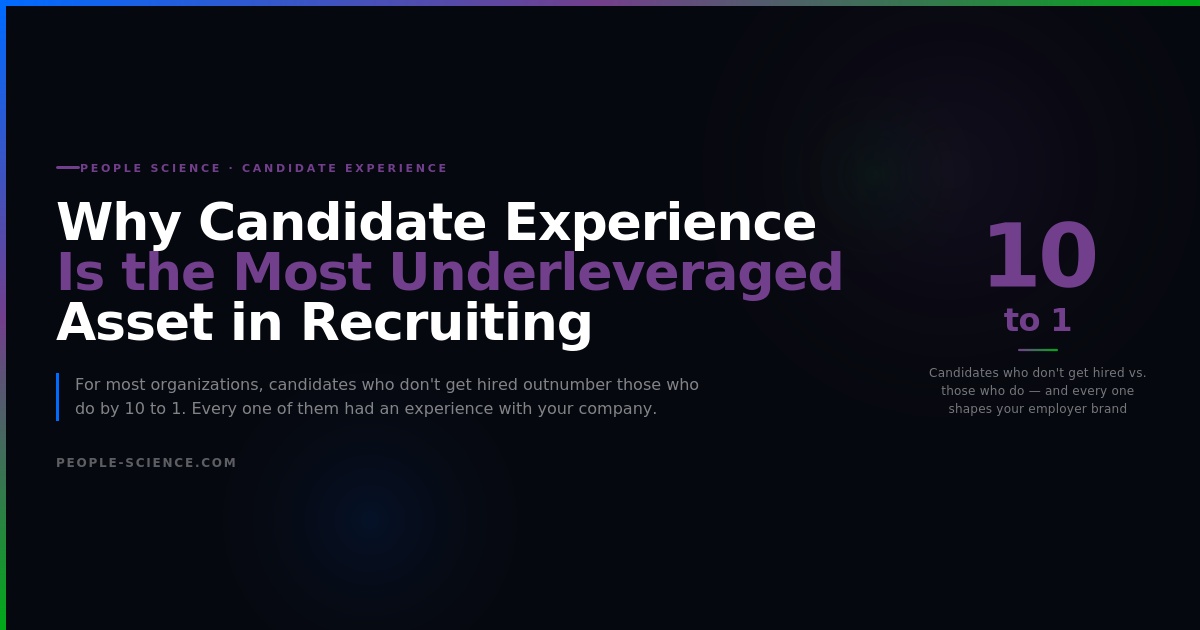
Here’s a number that rarely gets discussed: for most organizations, the candidates who don’t get hired outnumber the ones who do by a factor of 10 to 1, or more. Every one of those candidates had an experience with your organization. They formed an impression about your responsiveness, your professionalism, your clarity of communication, and …
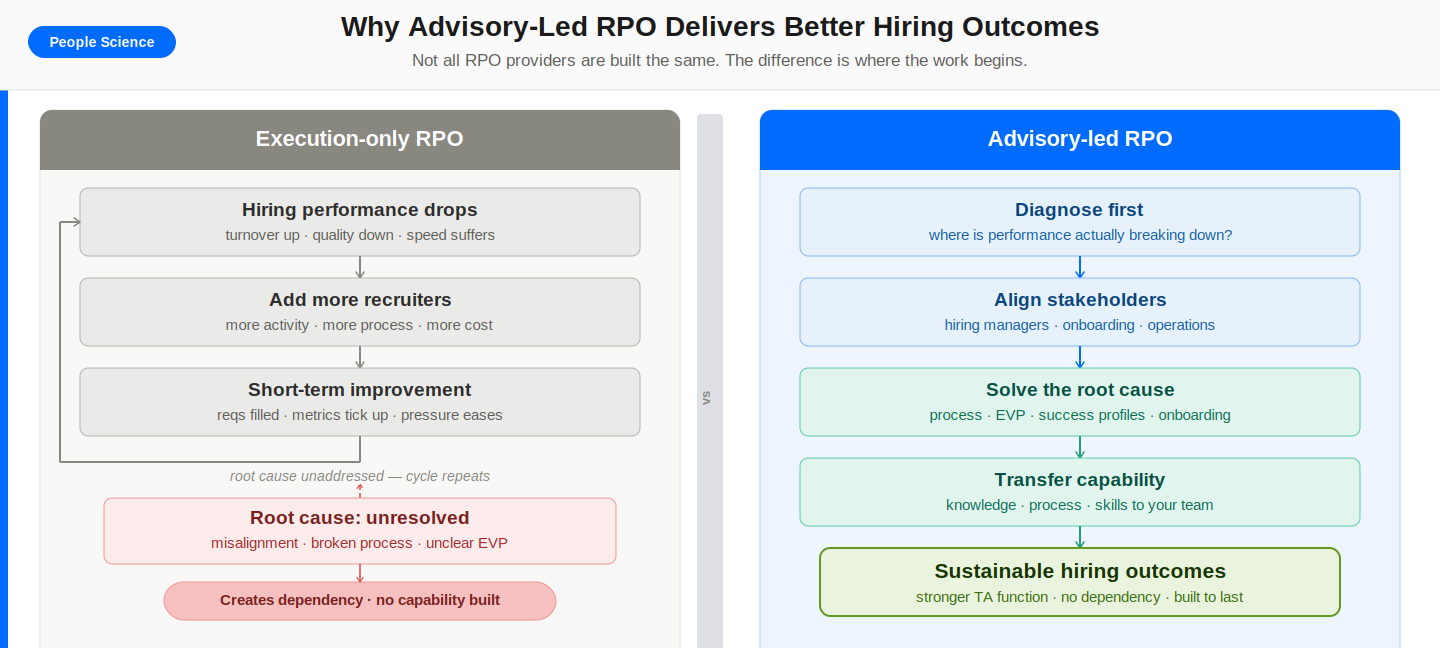
Read MoreAdvisory-led RPO delivers better hiring outcomes because it addresses the root causes behind recruiting challenges, not just the symptoms. Not all RPOs are built the same. Some providers are designed to execute. They bring recruiters, fill requisitions, and help organizations manage hiring volume. When the challenge is capacity, that model can work well. But when …
Read MoreThere’s a version of RPO that looks like success on the surface. Reqs get filled. Time-to-hire stays acceptable. Hiring managers stop complaining, at least for a while. Then something shifts. A wave of attrition hits. A new business unit opens. The market tightens. And suddenly, nobody can explain why the engine that worked six months …
Read More“Advisory” means different things depending on who you’re talking to. For some firms, it means a report. A set of recommendations delivered in a deck, with a handshake and a good luck. For People Science, it means something different – and the distinction matters more than most organizations realize before they engage. Here’s what a …
Read MoreMost TA leaders believe their candidate experience is better than it actually is. That’s not a criticism – it’s a structural problem. The people designing the hiring process rarely go through it. Recruiters see the internal side. Candidates experience the external side. And the gap between those two perspectives is where your employer brand is …
Read MoreSkills-based hiring has become one of the biggest shifts in talent acquisition over the last few years. Drop the degree requirement. Focus on what candidates can actually do. Hire for potential, not pedigree. In theory, it’s exactly right. In practice, it’s harder than most organizations expected, and the gap between intention and execution is where …
Read MoreMost organizations treat recruiting as a cost center, but a strong recruiting ROI framework shows that hiring outcomes directly impact revenue, retention, and organizational performance. Most teams measure what’s easy, such as time-to-fill, number of hires, and cost-per-hire — but those numbers alone don’t tell you whether you’re hiring effectively. They measure what’s easy, such …
Read MoreTalent Acquisition × AI Why AI Hiring Tools Give Conflicting Advice (and Why It Matters for TA Leaders in 2026) Based on real TA leader questions — April 2026 — People Science AI hiring tools often give conflicting advice. Yes, AI is changing the way we work—but if you’ve used ChatGPT, Claude, or Gemini, you’ve …
Read MoreRecruitment strategy is not the enemy of quality hiring. Poor systems are. In many organizations, the hiring model was never designed to handle the level of demand the business now expects. Hiring problems rarely start with the recruiter. They start when the business expects the hiring process to do something it was never built to …
Read MoreAI didn’t arrive in hiring quietly; it came with a promise: smarter, faster, fairer decisions. But concerns around AI bias in hiring are now front and center for employers. The first two scaled quickly. The third is still up for debate and, increasingly, for judgment in federal courts. AI-powered hiring tools processed over 30 million …
Read More