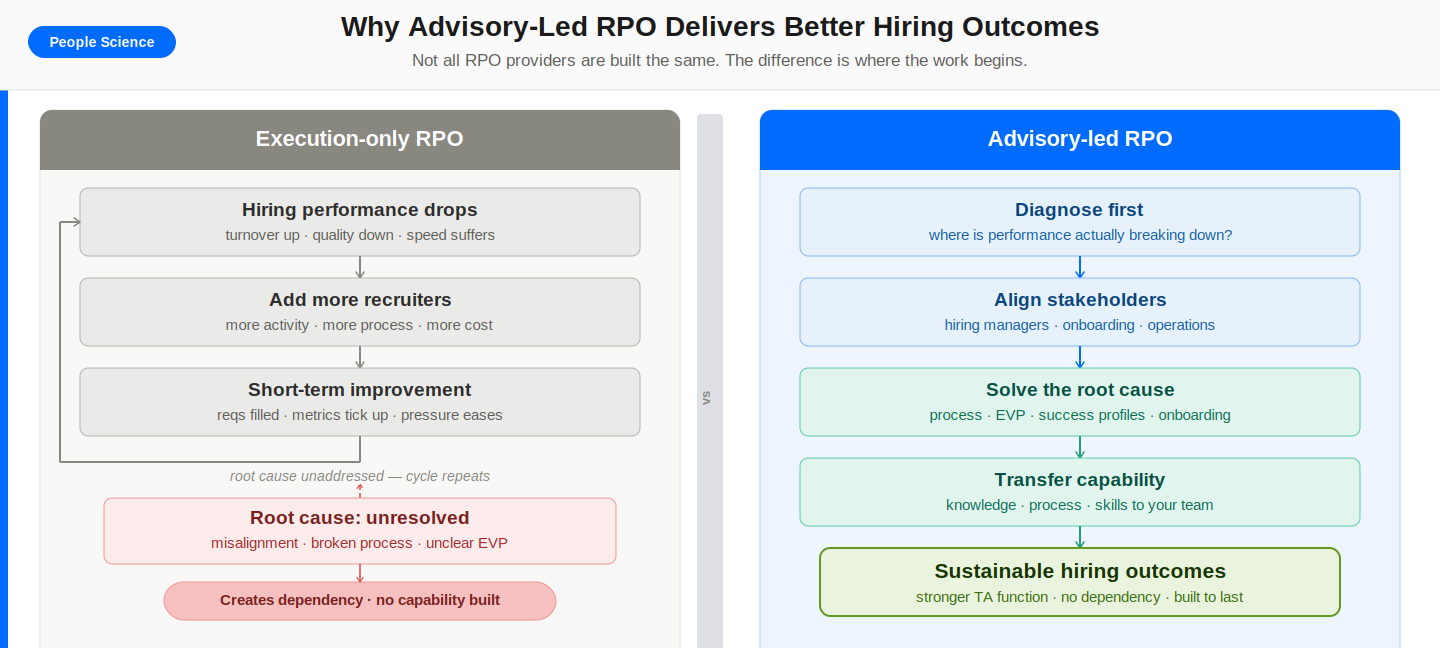
Advisory-led RPO delivers better hiring outcomes because it addresses the root causes behind recruiting challenges, not just the symptoms. Not all RPOs are built the same.
Some providers are designed to execute. They bring recruiters, fill requisitions, and help organizations manage hiring volume. When the challenge is capacity, that model can work well.
But when hiring challenges are symptoms of something bigger such as misaligned hiring managers, unclear candidate value propositions, broken processes, poor onboarding, or workforce planning gaps, more recruiters won’t solve the problem.
That’s where advisory-led RPO is different.
At People Science, we believe recruiting outcomes are the result of an entire talent ecosystem working together. Recruiting doesn’t operate in a vacuum. The quality of hires, speed of hiring, candidate experience, retention, and business performance are all connected.
If you’re only measuring the output, you’re often missing the root cause.
The Limits of an Execution-Only Approach
Traditional RPO engagements often focus on activity and output:
- Requisitions opened
- Candidates sourced
- Time-to-fill
- Cost-per-hire
- Offers accepted
Those metrics matter. But they don’t always explain why performance is improving, or why it suddenly isn’t.
We’ve seen organizations invest heavily in recruiting support only to find themselves facing the same challenges six months later. Hiring slows. Turnover increases. Candidate quality declines. The response is often to add more recruiters or more process.
But in many cases, the real issue isn’t recruiting capacity. It’s a structural problem somewhere else in the hiring journey.
When those issues go unaddressed, organizations become dependent on external support instead of building a stronger talent acquisition function.
What Advisory-Led RPO Looks Like
Our engagements begin with diagnosis, not deployment.
Before we assign recruiters, we work to understand where performance is breaking down and why.
- Are hiring managers aligned on what success looks like?
- Is the employer’s value proposition attracting the right candidates?
- Are candidates experiencing the organization the way leadership intends?
- Is onboarding setting employees up for long-term success?
- Are recruiting metrics telling the full story?
These questions matter because recruiting outcomes are rarely caused by a single function. They are usually the result of multiple systems interacting with one another.
Our advisors are practitioners who have led talent acquisition organizations, managed transformation efforts, and partnered directly with executive leadership teams. They know how to distinguish between a recruiting problem and a business problem that happens to be showing up in recruiting.
That perspective changes the conversation.
Instead of simply reporting results, we identify what’s driving them.
Instead of responding to symptoms, we solve underlying issues.
And throughout the engagement, we transfer knowledge, processes, and capabilities back to the client so the organization becomes stronger over time.
Organizations that choose advisory-led RPO gain more than recruiting support—they gain stronger hiring systems, better alignment, and long-term talent acquisition capability.
Advisory in Action
One B2C call center came to us after two large RPO providers had already attempted to solve a turnover problem.
On paper, the issue appeared to be recruiting.
In reality, recruiting, onboarding, training, and operations were completely disconnected. There was no shared definition of success, no consistent employee value proposition, and little alignment between talent acquisition and the business.
Our work began with diagnosis and stakeholder alignment.
By rebuilding the connection between recruiting, training, leadership, and operations, the organization reduced annual turnover from 98% to 32%, exceeded its hiring goal of 5,000 employees, and improved customer satisfaction by 43%.
We saw a similar pattern with a national healthcare nonprofit facing 161% annual turnover in critical roles.
The initial assumption was that recruiting needed to hire faster.
The deeper issue was misalignment across the hiring process. Expectations were unclear, onboarding didn’t reflect the realities of the role, and hiring managers weren’t actively shaping success profiles.
After aligning stakeholders and redesigning key elements of the hiring journey, turnover dropped below 40% in the first year and hiring cycle times improved by 25%.
Different organizations. Different industries. The common thread was that the hiring challenge wasn’t solved by recruiting alone. It was solved by identifying the root cause first.
The Question Every Organization Should Ask
When evaluating an RPO partner, ask a simple question:
What will our talent acquisition function look like when the engagement ends?
If the answer focuses only on positions filled, you’re evaluating an execution model.
If the answer includes stronger processes, better hiring manager engagement, improved decision-making, and a more capable internal team, you’re evaluating a strategic partnership.
At People Science, our goal isn’t to create dependency. Our goal is to leave organizations with a stronger, more effective talent acquisition function than the one we started with.
Because sustainable hiring success doesn’t come from adding recruiters. It comes from building the systems, alignment, and capabilities that make great hiring possible.