There’s a version of RPO that looks like success on the surface.
Reqs get filled. Time-to-hire stays acceptable. Hiring managers stop complaining, at least for a while.
Then something shifts. A wave of attrition hits. A new business unit opens. The market tightens. And suddenly, nobody can explain why the engine that worked six months ago isn’t working now.
This is the black box problem.
Many RPO providers operate on institutional knowledge: a mix of recruiter experience, internal tools, and informal processes that exist entirely inside the vendor organization. It produces results when conditions are favorable. It breaks down when they’re not. And it leaves the client with no diagnostic capability and no clear path to improvement.
That’s exactly why we designed the Recruiting Continuum – to change that.
What the Recruiting Continuum Is
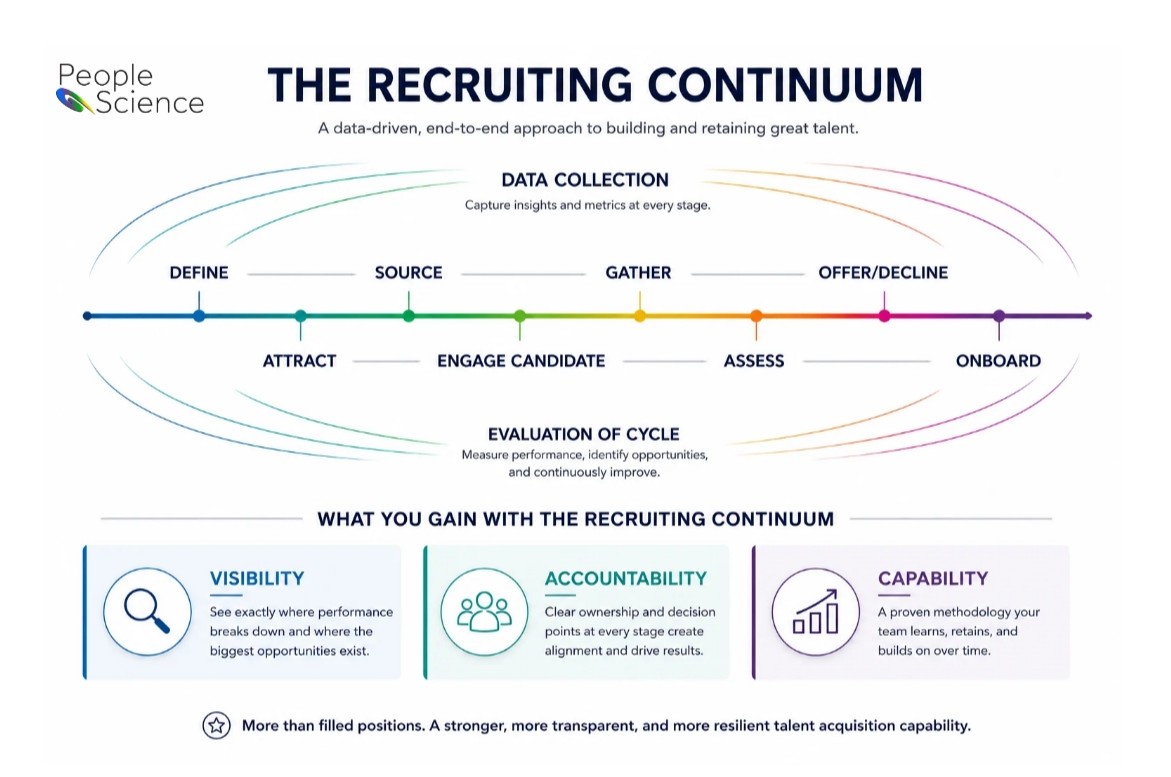
The Recruiting Continuum is People Science’s proprietary framework for managing the entire hiring lifecycle—from defining the role to onboarding the employee.
Each stage has defined inputs, outputs, ownership, decision points, and performance measures, creating visibility into where recruiting succeeds and where it breaks down.
It’s more than a process map. It’s an operating language.
What It Means in Practice
When a People Science engagement runs on the Recruiting Continuum, a few things become possible that aren’t possible in a black-box model.
Stage-Level Diagnosis
When fill rates slip, we don’t just look at outcomes. We identify where in the Continuum the breakdown is occurring – whether it’s sourcing volume, candidate engagement, assessment friction, offer acceptance, or onboarding effectiveness – and intervene at the right stage.
Shared Accountability
Your team and ours work from the same framework. There’s no ambiguity about who owns what, and no disconnect between what leadership believes is happening and what’s actually occurring within the process.
Capability Transfer
Over time, your team learns the Continuum. When an RPO engagement scales down or ends, you’re not left with a dependency. You’re left with a methodology your organization understands and can continue to execute.
Real-World Results
- A national nonprofit healthcare provider responsible for nearly 40% of the U.S. blood supply was experiencing 161% annual turnover among mobile collection staff.
- After mapping their hiring process against the Recruiting Continuum and redesigning sourcing, onboarding, and stakeholder alignment across key stages, turnover dropped below 40% by the end of Year 1, while the end-to-end hiring cycle improved by 25%.
- A rapidly growing B2C call center came to us with 98% turnover, 780 hires spread across multiple RPO vendors, and a mandate to scale to 5,000 employees within a year.
- By applying the Recruiting Continuum to align recruiting, onboarding, training, and operational leadership, turnover fell to 32% by Year 2, headcount exceeded 5,200 employees, and customer satisfaction increased by 43%.
Why This Matters for Mid-Market Organizations
Large enterprises often have internal TA leaders, workforce analytics teams, and operational resources that provide visibility into recruiting performance.
Most mid-market organizations don’t.
When an RPO engagement operates as a black box, the client has limited ability to understand what’s working, what’s failing, and how to improve outcomes.
The Recruiting Continuum is our answer to that challenge.
Visibility isn’t a feature of the partnership. It’s the foundation.
The Difference Between Filling Jobs and Building Capability
Results matter.
But understanding why you get those results matters even more.
An RPO engagement should leave you with more than filled positions. It should leave you with a recruiting capability that is stronger, more transparent, and more resilient than when you started.
That’s the difference between outsourcing recruiting and building a talent acquisition function.
Curious where the biggest opportunities exist in your hiring process?
Take the People Science Talent Acquisition Assessment to evaluate your organization across the Recruiting Continuum and identify where performance may be breaking down.